










Heart disease is the world’s biggest killer. In the United States, it claimed 931,578 lives in 2021—more than all cancers and chronic lung diseases together. These numbers are shocking, but they hide something even more troubling: who is dying, and why.
Cardiovascular disease (CVD) is not only a medical problem. It is a social crisis. It is a reflection of where people live, what they earn, and what resources they can access. And it is a moral issue, because these outcomes are not random—they are shaped by long-standing inequalities.
We must face the truth: heart disease hits some communities harder than others. These disparities are rooted in social and economic injustice.
The Unequal Burden of Cardiovascular Disease

Between 2017 and 2020, nearly half of all U.S. adults—about 127.9 million people—had some form of CVD. But the burden does not fall evenly.
Non-Hispanic Black adults carry the highest rates:
- 59.0% of Black women
- 58.9% of Black men
Many believe this gap is genetic. But expert clinicians remind us that race is a social construct, not a biological destiny. Research shows no clear genetic reason for these differences.
The real drivers are social:
- where people live
- what food they can buy
- what stress they carry
- what care they can access
In other words: inequity—not biology—is the strongest force behind these disparities.
How History Still Shapes Heart Health Today
To understand today’s health gaps, we must look backward.
In the 1930s, redlining maps labeled Black neighborhoods as “high-risk” zones. Banks refused to provide loans, insurance, or support. These communities were starved of investment and opportunity.
Decades later, those same neighborhoods show the highest rates of heart disease, diabetes, and stroke.
Why? Because redlining created:
- fewer grocery stores
- fewer parks
- poorer housing
- more environmental stress
- fewer medical services
Old maps created modern illness. This is how history becomes biology.
When Poverty Becomes a Risk Factor

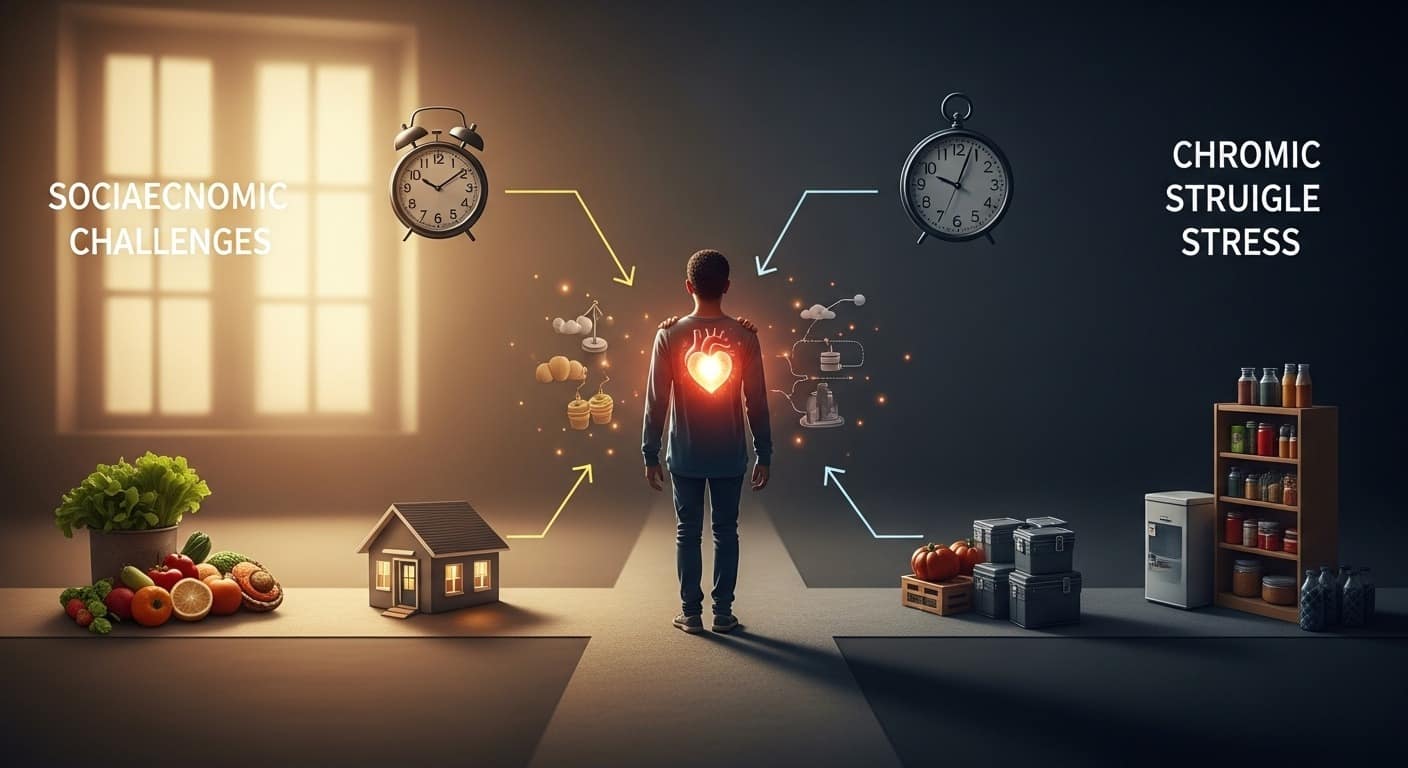
Socioeconomic status (SES) is one of the strongest predictors of heart health.
People with lower SES often face:
- limited education
- unstable employment
- unsafe living conditions
- low income
- chronic financial stress
Studies show that low SES raises heart disease risk as much as smoking, diabetes, obesity, or high blood pressure.
This is not only about money.
It is about the stress of survival.
Chronic stress increases hormones that raise blood pressure and blood sugar. Over years, that stress carves its way into the heart and arteries.
Two major social factors stand out: income and food insecurity.
When Basic Needs Aren’t Met, Health Suffers
Among older adults with diabetes:
- Low income (≤135% of the poverty level)
- and food insecurity
were linked to higher rates of heart attack, stroke, and heart failure.
Food insecurity affects Black households at far higher rates. This leads to:
- poor diet quality
- metabolic problems
- emotional distress
- unhealthy coping, including smoking
Medicine can’t fix what hunger and poverty create.
Healthcare access remains deeply unequal.
The Healthcare Gap: When Access Isn’t Equal
Uninsured adults are more likely to:
- delay care
- get poor-quality treatment
- have uncontrolled blood pressure
- have high cholesterol
Black and Hispanic adults have lower rates of insurance at every age. This inequality leads to later diagnoses, fewer treatment options, and worse outcomes.
Even with insurance, many face another barrier: trust.
A Crisis of Trust in the Healthcare System
Many people from marginalized communities walk into clinics already unsure if they will be heard.
This mistrust is not imagined. It comes from:
- unequal treatment
- biased assumptions
- rushed appointments
- poor communication
- historical trauma (including the Tuskegee experiment)
As one expert explains:
“Bias is often unintentional, but it shows in how providers speak, how they listen, and how much time they give.”
When trust breaks, patients avoid follow-ups, skip medications, or stay silent about symptoms.
That silence can be deadly.
To rebuild trust, healthcare must become truly culturally competent—care that respects each patient’s identity, history, and lived reality.
A Turning Point: From Data to Action

For years, experts measured disparities. Now, we must remove them.
The American Heart Association’s 2030 Impact Goal is to increase healthy life expectancy for everyone. This goal applies no matter their race, income, or zip code.
To reach this goal, health systems are urged to:
- screen for food insecurity
- ask about housing stability
- document social needs
- connect patients to resources
- work directly with community organizations
Dr. George A. Mensah of the NHLBI stresses:
“Most heart disease is preventable. We must work with communities to stop risk factors early.”
He reminds us that 34% of deaths from CVD occur before age 70—proof that these deaths are not inevitable. They are preventable.
We already know effective treatments. We already know healthy habits. What we need now is access, equity, and policy change.
A Call to Action: Change the Story of Heart Health
Fixing cardiovascular inequity is not the job of one group.
It requires policy makers, healthcare systems, community leaders, and every one of us.
We must:
- improve access to healthy food
- expand insurance coverage
- remove medical bias
- invest in historically excluded neighborhoods
- educate clinicians
- support community-based prevention programs
We can no longer allow income, race, or zip code to decide who lives long and who does not.
Heart health should never be a privilege.
It must be a right.
The future of cardiovascular health is modifiable.
Let us change it with justice, compassion, and courage.
Like, share, and subscribe to AMHG Magazine—because knowledge heals, stories inspire, and truth transforms. Every click fuels a movement where culture meets courage, and wellness becomes power. Don’t just watch change—be the heartbeat behind it.
Source: This article is based on insights and statistics drawn from the American Heart Association’s 2024 Heart Disease and Stroke Statistics Update, the CDC’s Preventing Chronic Disease reports, and comprehensive reviews of racial and socioeconomic determinants of cardiovascular health