









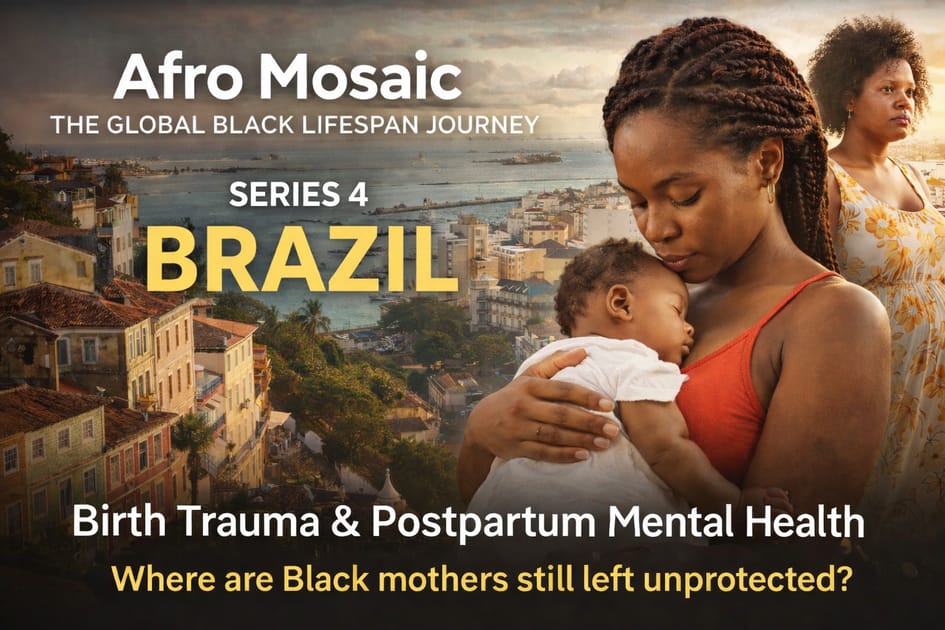
1. Introduction: The Invisible Postpartum Struggle
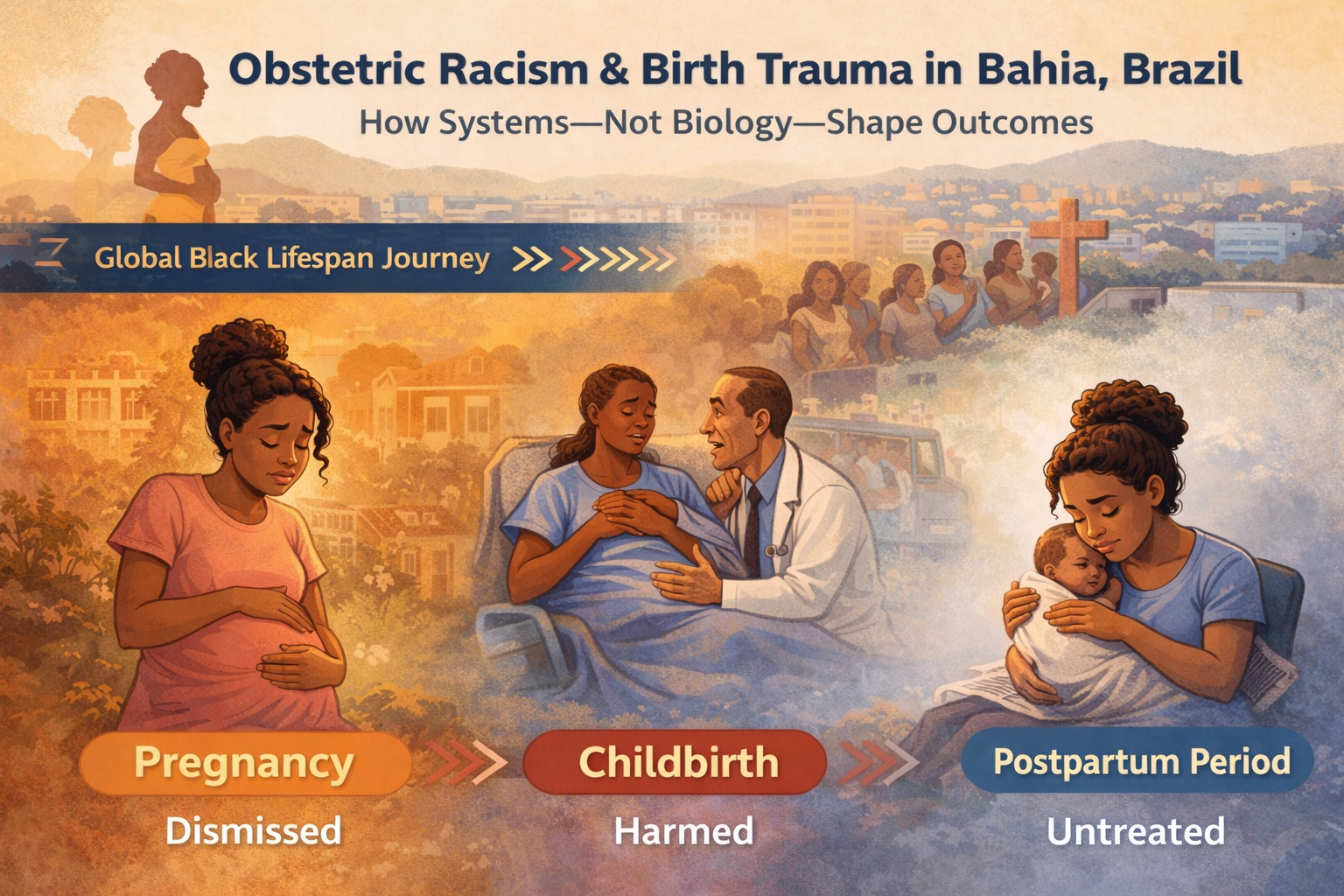
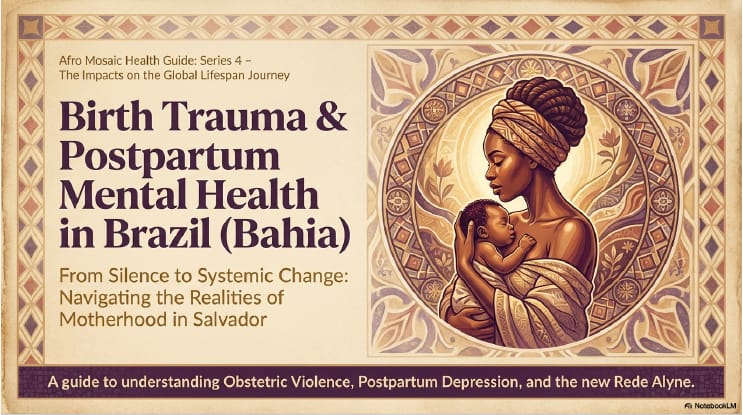
Birth Trauma & Postpartum Mental Health in Brazil (Bahia) is part of Afro Mosaic Health Guide Magazine’s Impacts On The Global Black Lifespan Journey, a year-long project dedicated to showing how systems shape Black lives from birth onward. This installment focuses on one of the most overlooked moments in that journey: what happens to Black mothers after the baby arrives.
The transition from pregnancy to the first year of life is more than a biological milestone; it is a high-stakes, multi-factorial struggle that defines the trajectory of the Black lifespan journey. For too long, we have treated birth trauma and postpartum depression (PPD) as individual medical failures. In the context of Bahia, Brazil, we must call it what it is: a systemic crisis fueled by racial inequality and institutional neglect.
For Black women, the stressors are unique and compounded. This is not just a “sadness” following birth; it is a mental health crisis where systemic failings often act to “trigger or aggravate” (desencadeador ou agravante) deep-seated suffering. To protect the next generation, we must look beyond the clinic. This exploration delves into the hard data of recent SciELO research and the transformative potential of the new Redehttps://onlinelibrary.wiley.com/doi/abs/10.1111/jlme.12008 Alyne initiative to understand how we can finally center equity in maternal care.
2. Takeaway 1: The Occupational Link—Why Your Job is a Mental Health Determinant

We must stop pathologizing the individual and start indicting the system. A systematic review published in SciELO (2024) reveals a “clear association” (nítida associação) between a woman’s occupational status and her risk of PPD. The workplace is not a neutral backdrop; it is a primary determinant of mental health.
The research identifies several high-risk occupational factors that jeopardize a mother’s well-being:
• Low pay and precarious conditions: Economic instability is a chronic psychological burden.
• Work exhaustion and high workloads: High professional demands impede the vital bonding and recovery period.
• Unemployment and job searches: Stress is specifically tied to the year prior to birth and “unsuccessful job searches” (Prelog et al., 2019).
• Overinvestment/Overcommitment (Superinvestimento no trabalho): Excessive psychological dedication to a job is linked to persistent, high-level depressive symptoms (Van der Waerden et al., 2015).
The SciELO review concludes with a powerful indictment:
“There is a clear association (nítida associação) between the risk of postpartum depression and the woman’s occupational situation… the occupational situation can become a triggering or aggravating factor (desencadeador ou agravante) for the woman’s mental health status.”
3. Takeaway 2: Rede Alyne—Centering Racial Equity in Maternal Care

In September 2024, the Brazilian Ministry of Health moved to replace the “Rede Cegonha” with Rede Alyne (Portaria GM/MS 5.350). This isn’t just a name change; it is a radical shift toward a “humanized and integral” care model designed to dismantle regional and ethnic-racial inequalities.
Rede Alyne explicitly targets the reduction of maternal and infant mortality among the Black and Indigenous populations (população negra e indígena). Crucially, the model extends support from the onset of pregnancy through the child’s growth from 0 to 24 months. It operationalizes this care through specialized units such as:
• AGPAR (Ambulatório de Gestação e Puerpério de Alto Risco): Specialized clinics for high-risk pregnancies and postpartum care.
• CPN (Centro de Parto Normal): Centers dedicated to natural, humanized childbirth.
• CGBP (Casa da Gestante, Bebê e Puérpera): Support housing for mothers and infants in transition.
4. Takeaway 3: The Right to “Vinculação”—Ending the Trauma of Birth Peregrination

One of the most violent experiences a laboring mother can face is “peregrination” (peregrinação)—the desperate search for a hospital bed while in active labor. In Salvador, Bahia, this is not just a logistical failure; it is a violation of legal rights.
The concept of “Vinculação” (Linking) is protected by Federal Law 11.634/2007 and, more specifically for local residents, by Salvador Municipal Law nº 7.851/2010. This framework ensures:
• Prior Knowledge: Every pregnant woman must know exactly which maternity hospital will handle her birth before labor begins.
• Visita Guiada (Guided Tour): Mothers have the legal right to visit their designated maternity ward during the prenatal period to meet the team and reduce anxiety.
• Mãe Bahia Program: This state initiative (Portaria nº 152/2025) works to decentralize assistance, ensuring that women can give birth within their own territories and avoid the trauma of being sent away during a crisis.
5. Takeaway 4: Protective Factors—The Science of Maternity Leave and Job Rewards

If we treat policy as a mental health intervention, the SciELO systematic review offers a clear roadmap of Protective Factors (fatores protetores) that can mitigate the risk of PPD. These are not perks; they are life-saving safeguards.
• Aumento da licença à maternidade (Increased Maternity Leave): Longer leave durations are scientifically associated with a marked decrease in depressive symptoms, particularly when they cover the critical first six months postpartum.
• Recompensas no trabalho (Job Rewards): Professional environments that provide adequate recognition and rewards for a woman’s effort act as a buffer against psychosocial stress.
When society values a mother’s professional and personal contributions, it creates a protective shield around her mental health.
6. Takeaway 5: A Local Web of Support—From CAPS to Community NGOs

When the system fails and a crisis hits, Salvador’s Rede de Atenção Psicossocial (RAPS) must be the safety net. For women in Salvador experiencing “intense distress” or “life-threatening” psychiatric situations, the 5th Health Center Clementino Fraga (Pronto Atendimento Psiquiátrico) provides 24/7 emergency care.
Beyond emergency services, the local network includes:
• CAPS (Centros de Atenção Psicossocial): Free, specialized spaces within the SUS for ongoing mental health treatment.
• Escuta que Acolhe: A vital initiative of the “Programa Acolher” (Fundação José Silveira), which provides a supportive psychological environment for those who have survived violence or deep emotional suffering.
This community-based philosophy is simple but profound:
“Caring for the mind is also caring for life!” (Cuidar da mente também é cuidar da vida!)
7. Conclusion: A Forward-Looking Reflection

Protecting the Black lifespan journey requires more than empathy; it requires structural accountability. From the workplace to the maternity ward, we must ensure that the “invisible” labor of postpartum recovery is supported by robust public policy and fair labor conditions. Programs like Rede Alyne and the legal protections of Vinculação in Salvador are essential steps, but they must be defended and expanded.
How can we, as a society, move from merely acknowledging maternal suffering to actively funding the systems that prevent it? We must hold our institutions to the standard that is their duty:
Health is a right—not a luxury. (A saúde mental é um direito — não é luxo).
Inside this presentation, readers will see how postpartum mental health is shaped not only by biology, but by work conditions, income insecurity, racial bias, legal gaps, and access to care. It connects research, policy, and lived experience into a clear story that explains why so many mothers suffer in silence—and what can be done to change that. If you care about maternal health, mental well-being, or building a safer future for Black families, this presentation is essential reading—and worth downloading and sharing. https://mly0iucdz15z.i.optimole.com/w:auto/h:auto/q:mauto/f:best/https://amhg.ca/wp-content/uploads/2026/01/image-1.png
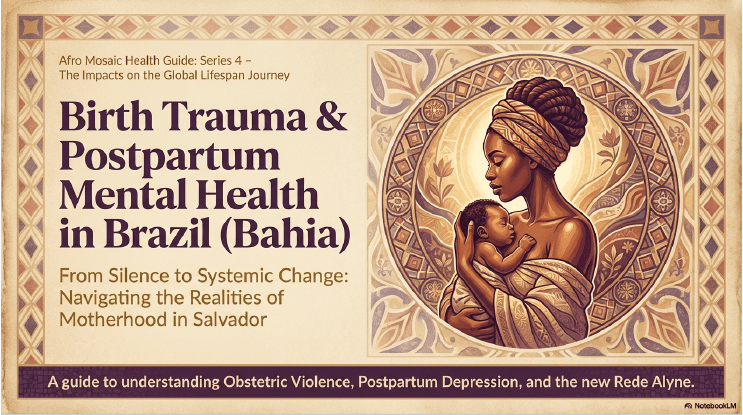
Birth Trauma & Postpartum Mental Health in Bahia, Brazil reveals what happens after the baby arrives.
For many Black mothers, postpartum mental health isn’t shaped by biology alone—it’s shaped by work conditions, income insecurity, racial bias, legal gaps, and access to care. These systems turn motherhood into a high-risk transition instead of a protected one.
This video exposes how birth trauma and postpartum depression are created by systems—not personal failure—and why silence continues to harm Black families.
Because protecting the Black lifespan begins with protecting mothers.